
Business activity has fallen by a fourth of the pre-COVID levels due to lockdowns imposed by states to contain the spread of the second wave of COVID-19, Japanese brokerage Nomura said on Tuesday. However, it said the falling activity levels will have a muted economic impact and maintained its growth estimates for the year, saying the lockdowns present "downside risks". As of April 25, the Nomura India Business Resumption Index (NIBRI) registered its steepest weekly fall in over a year of 8.5 percentage points to 75.9, which is 24 percentage points below pre-pandemic normal, the brokerage said in a statement.

The HSBC Services Purchasing Managers' Index , compiled by Markit, fell to 50.6 in August from 52.2 in July.

S&P Global Ratings on Tuesday kept India's economic growth forecast in the fiscal year to March 2022 unchanged at 9.5 per cent but raised its predictions for the subsequent year on broadening out of the recovery. The Indian economy had shrunk by 7.3 per cent in 2020-21 fiscal (April 2020 to March 2021) as pandemic induced restrictions battered business activity. The gradual lifting of the restrictions has helped the economy to rebound from pandemic lows.

The Nikkei India Services Purchasing Managers' Index (PMI), which tracks services sector firms on a monthly basis, stood at 48.7 in January, as against 46.8 in December 2016.

Global trends, macroeconomic data announcements and the start of the earnings season would be the major drivers for the equity markets in a holiday-shortened week, analysts said. Equity markets will remain closed on Thursday for Eid-Ul-Fitr. Trading activity of foreign investors, rupee-dollar trends and crude oil prices would also guide trends in markets.

The country's gross domestic product (GDP) is expected to grow at around 18.5 per cent with an upward bias in the first quarter of the current financial year, according to SBI research report Ecowrap. This estimate is lower than the Reserve Bank of India's GDP growth projection of 21.4 per cent for the April-June quarter. "Based on our 'Nowcasting' model, the forecasted GDP growth for Q1 FY22 would be around 18.5 per cent (with upward bias)," the report said. Higher growth in Q1 FY22 is mainly on account of a low base.

In 2024, the Securities and Exchange Board of India (Sebi) implemented significant reforms, focusing on cooling down the derivatives segment, enhancing transparency and accountability in small and midsised enterprise (SME) listings, and deepening the fund management ecosystem.

China posted the sharpest increase in output for 15 months, while India saw the steepest expansion since February 2013.

Services sector slowed down in May on weak economic factors.

The Nikkei India Services Purchasing Managers' Index, which tracks the services sector firms on a monthly basis, stood at 50.3 in February, up from 48.7 registered in January.

The Sensex has now lost 878.32 points in six sessions -- its longest string of losses in six months.

The survey showed firms' confidence regarding future business grew at the slowest pace in a year last month.
The Nikkei India Services Purchasing Managers' Index, which tracks services sector companies on a monthly basis, stood at 52 in September, down from August's 43-month high of 54.7, pointing to a slower and moderate rate of expansion.

India's manufacturing sector activities moderated in August, as business orders and production rose at softer rates due to the pandemic and rising input costs, a monthly survey said on Wednesday. The seasonally adjusted IHS Markit India Manufacturing Purchasing Managers' Index (PMI) stood at 52.3 in August, down from 55.3 in July, indicating a softer rate of growth that was subdued and below its long-run average. The August PMI data pointed to an improvement in overall operating conditions for the second straight month.

The HSBC Emerging Markets Index, a monthly indicator derived from Purchasing Managers' Index surveys, inched up to 50.6 in May from 50.4 in April, indicating weak output growth across global emerging markets.
Investors went looking for bargain in banking, oil and gas and auto stocks.

Ask rediffGURU and PF and MF expert Janak Patel your mutual fund and personal finance-related questions.

'Whether I am optimistic or pessimistic is not the issue; I am just going by the evidence available.' 'The Indian economy and financial sector are now well-placed and very resilient in dealing with any kind of spillover coming from the external world.'

Services growth at 5-month low in Nov as confidence slumps.

A reading below 50 means contraction in the sector.

On the lines of Shariah-compliant products, intermediaries ask exchanges to consider investment benchmark.

India's manufacturing sector activities eased slightly in February but firms were upbeat as they responded to increased new work intakes by stepping up production and purchasing activities, a monthly survey said on Monday. The seasonally-adjusted IHS Markit India Manufacturing Purchasing Managers' Index (PMI) fell marginally to 57.5 in February from 57.7 in January, indicating that even though the pace of growth eased from January it remained sharp in the context of historical data. The headline figure for February remained above its long-run average of 53.6, the survey noted. In PMI parlance, a print above 50 means expansion while a score below 50 denotes contraction.

The HSBC/Markit Purchasing Managers Index for the services industry inched up to 47.2 in November from 47.1 in October, the fifth sub-50.0 reading and indicated an output contraction across the Indian service economy.

The total value of India's top 100 brands has increased by 2 per cent, from $162.1 billion in 2020 to $164.9 billion in 2021, according to the latest Brand Finance India 100 2021 report. This uplift in brand value over the course of the first year of the pandemic is an impressive feat given the global economic crisis following the implementation of national lockdowns in March 2020, when business activity was brought to a halt, affecting both production and consumption. Among the brands that came on the top of the list include Tata Group, Reliance Industries, and Mahindra Group.

A reading above 50 means the sector is expanding, while a reading below 50 means contraction.

Movement in the equity market this week will largely be dictated by quarterly earnings of blue-chip firms HDFC Bank and Hindustan Unilever, along with the announcement of WPI inflation data and global trends, analysts said. Trading activity of foreign investors, global oil benchmark Brent crude and rupee-dollar trend would also guide the movement.

The Sensex ended up 244 points at 28,504 on strong global cues.
.jpg)
Although the survey pointed to the softness in demand leveling off, a complete recovery is still some way off.

Sectorwise, oil & gas and BFSI (banking, financial services and insurance) witnessed the maximum year-on-year growths of 27 per cent and 17 per cent in December 2014.

The HSBC India Manufacturing Purchasing Managers' Index for the manufacturing industry climbed from 49.6 in October to 51.3 in November on the back of a rebound in new orders and output.
Auto and realty shares were among the top Sensex gainers.
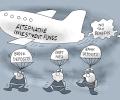
Portfolio management services (PMS), catering to higher networth individuals (HNIs), are facing tough competition from emerging alternative investment funds (AIFs), evident from their dwindling client base. In May, the number of clients for the industry stood at 125,390, down 20,528 in two months, shows data from the Securities and Exchange Board of India (Sebi). "PMS managers also have a high active ratio, which means their portfolios are quite differently positioned and more actively managed, compared to the benchmark, which is also a highlight for long-term investors.

'To the believers of crypto regulations, I have only one question to ask, how will you regulate it?'

'Just the amount of work which is there just to become more and more successful in banking. For this to happen you need to have leaders who understand technology.'

The joint venture of Jio Financial Services and BlackRock to foray into India's asset management space could be disruptive but not disastrous for incumbent industry players, analysts said on Thursday. As an investment strategy, analysts suggest investors stay put in shares of those AMCs that consistently improve business metrics, and where market capitalisation-to-asset under management (AUM) valuation is not stretched. However, growth expectations of incumbent players may get trimmed in the medium-to-long term, analysts said, once the Jio-BlackRock JV unveils its plans, discounting the looming challenge as significant enough to dent their profitability.
.jpg)
The HSBC Emerging Markets Index, a monthly indicator derived from the PMI surveys, continued its upward trajectory in November on the back of faster manufacturing growth.

Bubbles can inflate indefinitely and also burst, with deep corrections, warns Devangshu Datta.

Unified Payments Interface (UPI), the flagship payments platform of the National Payments Corporation of India (NPCI), made a record in volume and value of transactions in July as digital payments rise in the pandemic. UPI processed a record 3.24 billion transactions in July up 15.7 per cent from June when it processed 2.8 billion transactions. In value terms, in July, the platform processed transactions worth Rs 6.06 trillion, up 10.76 per cent from June.

Indian equity markets have a limited upside potential in the near-term as they negotiate the ensuing cyclical slowdown, wrote analysts at Nomura in a recent coauthored report led by Saion Mukherjee, their managing director and head of equity research for India. He, however, believes that the foundations are in place for sustainable growth over the medium-to-long term, and hence suggests a 'buy on dips' strategy to equity investors. As an investment strategy, Nomura prefers domestic-oriented sectors and companies over exporters, and prefers stocks that provide valuation comfort. Industrials and banks are their overweight sectors, while IT services and consumer discretionary are their underweight sectors.

Hiring activity in the country touched an all-time high in July, witnessing a 11 per cent sequential increase, indicating a strong revival of economic growth and a recovery of business from the impact of COVID-19, a report said on Friday. With 2,625 job postings, hiring trends grew 11 per cent in July compared with 2,359 postings in June, the highest it has ever been, including the pre-COVID-19 timeline, according to the report by Naukri JobSpeak. The Indian job market has witnessed sequential growth for the second month in a row, with a 15 per cent rise in June, after the pandemic-linked decline in April and May, it stated.
 © 2026 Rediff.com - Advertise with us - Disclaimer - Privacy Policy - Sitemap - Feedback - About us - Terms of use - Grievances